
A deep transfer regression method based on seed replacement considering balanced domain adaptation
Published in July 17, 2022
Contribution
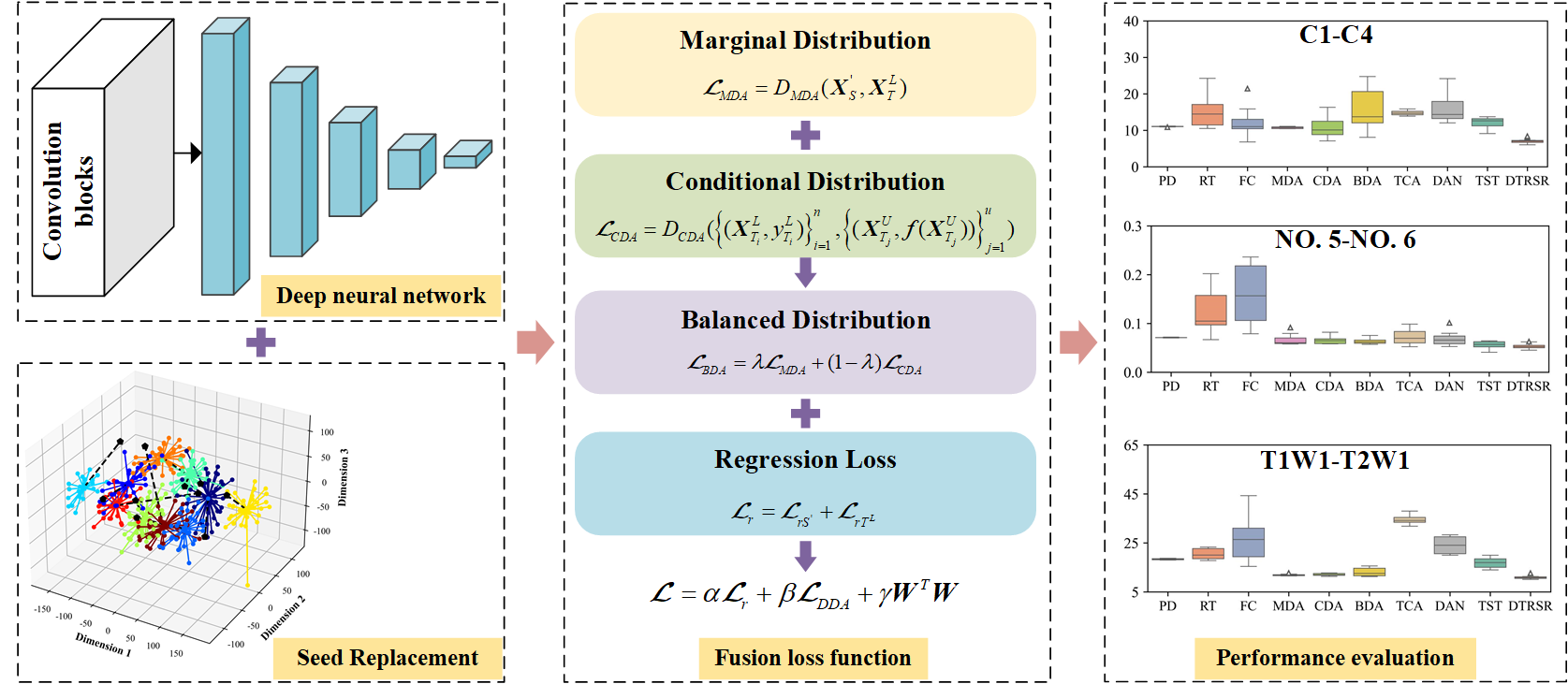
A deep transfer regression method based on seed replacement considering balanced domain adaptation, called DTRSR, was proposed in this paper.
First, the knowledge of the source domain is transferred to the target domain at the model level by structure freezing and parameter transfer. Second, the knowledge of the source and target domains is actively inherited at the data level by seed replacement. Finally, balanced distribution adaptation considering the marginal distribution difference and conditional distribution difference is added to the fusion loss function, achieving a more adequate learning of domain knowledge at the loss function level. In summary, domain knowledge is actively and fully learned through DTRSR at the model, data and loss function levels. The DTRSR has been verified on two public datasets (Tool Wear and Battery Capacity) and a private dataset (Robot Machining Errors), and achieves the best performance on most of the 18 tasks, which validates its effectiveness and great potential in regression tasks. In addition, the analysis of the results shows that DTRSR has a great advantages in terms of stability of performance and significance of effect, which indicates the great possibilities and prospects for the application of DTRSR in related engineering fields.
Graphic Abstracts
The graphic abstract is shown below
Source Code
You can find the source code in DTRSR!
Recommended citation: T. Zhang, H. Sun, F. Peng, S. Zhao, R. Yan, A deep transfer regression method based on seed replacement considering balanced domain adaptation, Eng. Appl. Artif. Intell., 115 (2022) 105238, https://doi.org/10.1016/j.engappai.2022.105238. https://doi.org/10.1016/j.engappai.2022.105238